KitchReviews, compare products, and make smarter decisions for your kitchen today.

Ever felt frustrated when your favorite meal sticks to the pan? It’s a common problem many home chefs face. But, professional kitchens use these durable pans for a reason. They distribute heat well and last longer than cheaper options.

These pans don’t come with a factory coating. But, you can make them nonstick with the right method. Learning how to make stainless steel cookware nonstick changes your cooking game. By controlling heat and using fat correctly, you turn a regular pan into a top-notch tool.
Understanding the science behind making stainless steel cookware nonstick changes your kitchen. You’ll see your pans aren’t bad; they just need the right technique. Once you learn these simple steps, you’ll enjoy stainless steel cookware nonstick performance every time you cook.
Key Takeaways
- Professional chefs prefer these pans for their durability and heat control. In fact, food sticking is usually a result of improper temperature management.
- However, Food sticking is usually a result of improper temperature management.
- You do not need chemical coatings to achieve a slick cooking surface.
- Instead, Proper preheating is the most critical step for success.
- Using the right amount of fat creates a protective barrier for your food.
Understanding the science of stainless steel surfaces
In fact, The secret to a perfect sear is in the tiny details of your cookware. Your pan might look smooth, but it’s actually full of tiny peaks and valleys. Therefore, To get the most out of stainless steel cookware nonstick, you need to understand these tiny changes.
The microscopic structure of steel
Under a high-powered microscope, your pan looks like a world of tiny peaks and valleys. These small gaps are why food sticks to the metal. When cold ingredients meet a cold pan, they fill these gaps, making it hard to flip or stir.
How heat affects metal expansion
Heat changes everything. As the pan heats up, the metal’s molecules start moving and spreading out. This makes the metal expand and the tiny gaps shrink, creating a smoother surface for food.
By heating your pan right, you make it nonstick temporarily. This change is key to cooking well with stainless steel. Check out the table below to see how temperature affects your cookware.
| Condition | Pore Status | Food Interaction |
|---|---|---|
| Cold Pan | Open and porous | High risk of sticking |
| Heated Pan | Contracted and smooth | Reduced adhesion |
| Overheated | Surface degradation | Risk of burning |
Knowing this science lets you use your stainless steel cookware nonstick to its best. Once you understand how heat changes the metal, you can cook better with your pans.
Why food sticks to your pans
Ever wondered why your eggs stick to your favorite stainless steel skillet? It’s frustrating when you can’t get a clean release. Learning how to use stainless steel cookware without sticking starts with understanding the science.

The role of protein bonding
Stainless steel isn’t as smooth as it looks. When you put protein-rich foods like eggs, fish, or chicken in a cold pan, proteins bond with the metal. As the pan heats up, food molecules settle into the steel’s tiny pores.
This creates a strong chemical bond, making food feel glued to the bottom. If you flip the food too soon, you’ll damage the protein’s surface. So, patience is key in the kitchen.
Common mistakes that lead to sticking
Most home cooks add food to a pan that’s too cold. If the metal is not hot enough, it grabs onto your ingredients. Incorrect temperature control is the main cause of sticking.
Another mistake is moving food too early. People often want to poke or flip their ingredients right away. To prevent sticking, let the food form a crust first. This crust acts as a barrier between the protein and the metal.
Why stainless steel is still the professional choice
Professional chefs mostly use stainless steel because of its incredible durability and heat resistance. Unlike nonstick coatings, stainless steel lasts for decades. It also distributes heat well, which is crucial for a perfect sear.
Mastering temperature control with stainless steel cookware offers unmatched control. It’s a reliable choice that consistently delivers delicious results with practice.
Essential tools for successful cooking
Mastering stainless steel cookware is not just about technique. It also requires the right tools. Investing in quality gear helps you control your cooking better. Follow these stainless steel cookware non stick tips to make your kitchen work like a pro’s.

Choosing the right spatula
The tool you use to handle your food is crucial. A metal spatula can scratch your cookware, creating grooves for food to stick and burn. Choose tools that protect your cookware and give you the right amount of leverage.
Here are some tools to add to your kitchen:
- Silicone spatulas: These are heat-resistant and gentle, ideal for delicate tasks.
- Wooden turners: A classic choice that’s sturdy for scraping up browned bits without damaging the metal.
- High-heat nylon tools: They offer a balance of rigidity and safety for your pans.
The benefits of heavy-bottomed pans
If food keeps burning in certain spots, your pan might be the problem. Thin metal pans often have hot spots, leading to uneven cooking and sticking. A heavy-bottomed pan is a key stainless steel cookware non stick tip.
These pans have a thick core of aluminum or copper between stainless steel layers. This design ensures consistent heat distribution across the cooking surface. Even heat prevents overheating that causes food to stick too much.
“A heavy-bottomed pan acts as a thermal battery, holding onto heat and releasing it steadily, which is essential for precise cooking.”
How to make stainless steel cookware nonstick
Learning how to make stainless steel cookware nonstick can change your kitchen. Many think only special coatings work, but it’s really about how you prepare. With a few simple steps, you can get pro results with what you already have.

Step 1: Preheat the pan properly
The key to making stainless steel cookware nonstick is preheating. Put your empty pan on the stove over medium heat for two to three minutes. This makes the metal expand evenly, giving you a smooth surface for cooking.
Don’t let your pan get too hot. If it does, your oil might smoke or burn, ruining your dish. Being patient is crucial for mastering this technique.
Step 2: The importance of room temperature ingredients
When your pan is ready, think about your ingredients’ temperature. Cold food dropped into a hot pan can cause it to cool down too fast. This can make your food stick to the pan.
Always try to warm your proteins or veggies to room temperature before cooking. This keeps the pan hot, which is key for how to make stainless steel pan nonstick. Your food will sear well without sticking to the pan.
Step 3: Adding oil at the right moment
Adding oil is all about timing. Wait until your pan is fully preheated before adding oil. When you pour in the oil, it should shimmer or move easily across the surface. This means it’s ready to coat the metal.
| Preparation Step | Action Required | Goal |
|---|---|---|
| Preheating | Medium heat for 3 minutes | Uniform metal expansion |
| Ingredient Prep | Bring to room temperature | Prevent thermal shock |
| Oil Application | Add after preheating | Create a protective barrier |
By following these steps, you create a natural barrier between your food and the metal. This method lets you cook with confidence, using the durability of stainless steel. With practice, sticking will become a thing of the past.
Mastering the water droplet test
Learning how to make stainless steel pan nonstick is simple. Just watch how water acts when heated. This method is key for home cooks aiming for professional results without food sticking. By noticing a few physical signs, you can get your surface ready for any meal.

Identifying the Leidenfrost effect
When your pan is hot enough, you’ll see the Leidenfrost effect. A water droplet will glide on the metal like a marble. The droplet’s bottom vaporizes, creating steam that keeps the water from the pan.
This shows the metal is hot enough for a nonstick layer. When water beads up and slides, your pan is ready for cooking. It’s a sure sign you’ve mastered how to make stainless steel pan nonstick.
What to do if the water evaporates instantly
If water sizzles and disappears fast, the pan is too cold. It hasn’t reached the right temperature for steam. Keep heating the pan for another minute before testing again.
Adding food too soon can cause sticking. Patience is crucial when learning how to make stainless steel pan nonstick. Wait until water beads up, not vanishes.
Adjusting heat based on droplet behavior
Water droplets that shatter and bounce mean the pan is too hot. Take the pan off the burner to cool down.
Here’s a guide to help you understand your results and adjust the heat:
| Droplet Behavior | Temperature Status | Recommended Action |
|---|---|---|
| Instant evaporation | Too cold | Increase heat slightly |
| Gliding/Dancing | Perfect | Add oil and cook |
| Shattering/Bouncing | Too hot | Remove from heat |
By watching these signs, you control your cooking space. Regular practice will make you a pro at how to make stainless steel pan nonstick every time.
The importance of fat and oil management
Managing fat well makes your stainless steel cookware nonstick. Heat control is key, but the right fat is crucial too. It keeps your food from sticking to the metal. Follow these stainless steel cookware non stick tips for a smooth cooking experience.

Choosing the right cooking fats
Not all fats handle heat the same way. Choose oils with a high smoke point like avocado oil or grapeseed oil. These oils stay stable and won’t burn when you sear food.
“The secret to great cooking is not just the ingredients, but the medium through which you apply the heat.”
Don’t use butter or extra virgin olive oil for high heat. They burn easily because of milk solids. Using the right oil is a key stainless steel cookware non stick tip for a clean pan.
How much oil is actually needed
Many people use too much oil, thinking it prevents sticking. But, you only need a thin layer. Too much oil can mess up searing and cooking.
Begin with a teaspoon of oil and adjust as needed. You want enough to cover the pan’s bottom but not so much that it’s deep-frying. A thin, shimmering layer is enough to protect the surface.
Distributing oil evenly across the surface
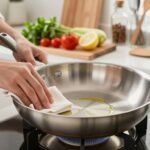
After adding oil to a hot pan, make sure it covers the whole area. Gently tilt the pan to spread the oil evenly. You can also use a silicone brush or a folded paper towel to spread it thinly.
This step ensures your food has a protective layer. By following these stainless steel cookware non stick tips, your food will release easily without sticking.
Temperature control techniques for different foods
Mastering heat management is key to professional results in your kitchen. A reliable stainless steel cookware cooking guide shows that ingredients react differently to heat. Adjusting your stove settings for each ingredient is crucial for success.
Cooking delicate proteins like fish
Fish needs a gentle touch to avoid flaking or sticking to the pan. Start by preheating your pan over medium heat and add a small amount of oil. Patience is your greatest asset when cooking fish; don’t flip it too early.
- Pat the fish dry with a paper towel to remove excess moisture.
- Wait until the fish releases naturally from the surface before attempting to turn it.
- Use a thin, flexible spatula to slide under the protein smoothly.
Searing meats without the mess
For a deep, flavorful crust on a steak or pork chop, high heat is needed. But high heat can cause splattering. Always make sure your meat is at room temperature and dry before cooking.
If you see smoke, your pan is too hot. Turn the dial down a bit. A well-seared piece of meat will naturally release from the pan once it’s done. If it feels stuck, cook it for another thirty seconds.
Handling eggs and other sticky foods
Many home cooks struggle with eggs, but learning how to fry in stainless steel pan without sticking is possible. The trick is to use lower heat and plenty of fat. Eggs are very sensitive to temperature spikes, which cause them to stick to the steel.
Keep your heat low-to-medium to control the cooking. Use a lot of butter or oil to create a barrier. This keeps your breakfast favorites from sticking. By being attentive and avoiding too much heat, your stainless steel pans will be as versatile as any nonstick pan.
Troubleshooting common sticking issues
Even the most seasoned chefs sometimes struggle with food sticking to their stainless steel pans. Figuring out how to use stainless steel cookware without sticking takes time and patience. When food starts sticking, act fast to save your dish.
What to do if food starts to stick
If stirring feels hard, your pan might be too hot or not have enough fat. Take the pan off the heat to stop food from sticking. Adding a bit of liquid, like broth or wine, can help food release from the pan.
“Cooking is a craft that rewards patience; when your pan resists, take a breath, adjust your heat, and let the surface do the work for you.”
Recovering from a burnt-on mess
Don’t worry if you get a stubborn, burnt layer. To fix it, deglaze the pan with water or vinegar while it’s still warm. After it cools, a warm, soapy water soak should loosen the stuck bits. Avoid using harsh steel wool to prevent scratches and future sticking.
Adjusting your technique for gas versus electric stoves
Your stove type affects how you manage heat. Gas stoves let you quickly adjust the flame to avoid sticking. Electric stoves, like glass-top models, hold heat longer, so move the pan to a cooler burner to prevent burning.
To master how to fry in stainless steel pan without sticking, learn to adjust for your stove type. Use this guide to improve your heat management.
| Stove Type | Heat Response | Best Practice |
|---|---|---|
| Gas | Immediate | Lower flame instantly |
| Electric Coil | Moderate | Move to a cooler burner |
| Induction | Very Fast | Reduce power setting |
By mastering these adjustments, you’ll find how to fry in stainless steel pan without sticking becomes easy. Regular practice keeps your cookware reliable for years.
Cleaning and maintaining your nonstick surface
Proper care is key to keeping your pans nonstick. When you treat your cookware right, it gives you great results every time. Learning how to stop food sticking to steel pans means keeping the surface clean.
Safe cleaning methods for stainless steel
Always let your pans cool down before washing them. Sudden changes in temperature can warp the metal. This warps the flat surface needed for even cooking.
Use warm, soapy water and a soft sponge or microfiber cloth to clean. Avoid harsh steel wool or abrasive scouring pads. These can scratch the surface, making food stick more.
Removing stubborn residue without damaging the finish
If you find burnt-on bits, don’t use a metal scraper. Make a paste with baking soda and water instead. Apply it to the area and let it sit for a few minutes.
Then, gently scrub with a soft cloth or non-abrasive nylon brush. For tough stains, add white vinegar. This method works well and keeps your pans looking new.
Seasoning your stainless steel for better performance
Stainless steel can be seasoned like cast iron. It doesn’t need a heavy process, but a thin layer of oil helps. This trick is great for how to stop food sticking to steel pans.
To season, heat the pan over medium-low heat and add a teaspoon of oil. Spread it evenly with a paper towel. Let it smoke slightly, then remove it from the heat. Wipe off any extra oil, and your pan is ready for better cooking.
Conclusion
Starting to change your kitchen starts with knowing your tools. This guide on stainless steel cookware is your first step to cooking like a pro at home.
You now know how to control heat and fat. Every dish you make is a chance to get better and feel more confident cooking.
Brands like All-Clad or Demeyere work best if you understand the metal’s physics. Following this guide keeps your pans reliable for years of cooking.
Share your favorite recipes or cooking challenges. Your cooking journey is just starting, and your feedback helps others improve too.
FAQ
Is it actually possible to achieve a nonstick surface with stainless steel?
Yes, it is! Stainless steel doesn’t have a chemical coating like Teflon. But, you can make it nonstick by using the Leidenfrost effect. Heat your pan to the right temperature. This makes the metal expand and the tiny pores shrink, creating a smooth surface.
What is the “water droplet test” I keep hearing about?
It’s a key method for checking your stainless steel pan. To do it, drop a small amount of water on your hot pan. If it sizzles and evaporates, it’s too cold. If it dances like a marble, your pan is ready.If the water beads up and moves, your pan is perfect. But, if it splits into many tiny beads, it’s too hot.
Why does my chicken or steak always seem to tear when I try to flip it?
It’s because of protein bonding. Cold proteins stick to the metal. But, when your food gets a good sear, it will release itself. If it’s sticking, wait a minute. Your food will tell you when it’s ready to flip.
Do I need to use a specific type of oil for a nonstick experience?
Yes, use oils with high smoke points like avocado oil or grapeseed oil. Avoid nonstick sprays, as they can leave a sticky residue. This is hard to clean from good brands like All-Clad or Made In.
How can I fry delicate items like eggs without them sticking?
It’s all about controlling the heat. After the water droplet test, add fat (like butter) and then turn the heat down. Use room temperature eggs to prevent the pan’s temperature from dropping too much.
Is it necessary to season stainless steel like a cast iron skillet?
Seasoning isn’t necessary, but it helps. Heat oil until it smokes, then wipe it away. This fills the pores and makes the pan nonstick.
What are the best tools to use with my stainless steel pans?
Use a high-quality spatula, metal or silicone. A thin, flexible metal spatula is great for delicate foods. It won’t disturb the surface tension you’ve created.
My pan has stubborn white spots or burnt-on grease; how do I fix it?
Your pan isn’t ruined! For “rainbow” stains, vinegar works well. For tough stains, Bar Keepers Friend is the best. Keep your pan clean for future nonstick cooking.
Explore other cookware reviews on KitchReviews to find the right kitchen essentials.